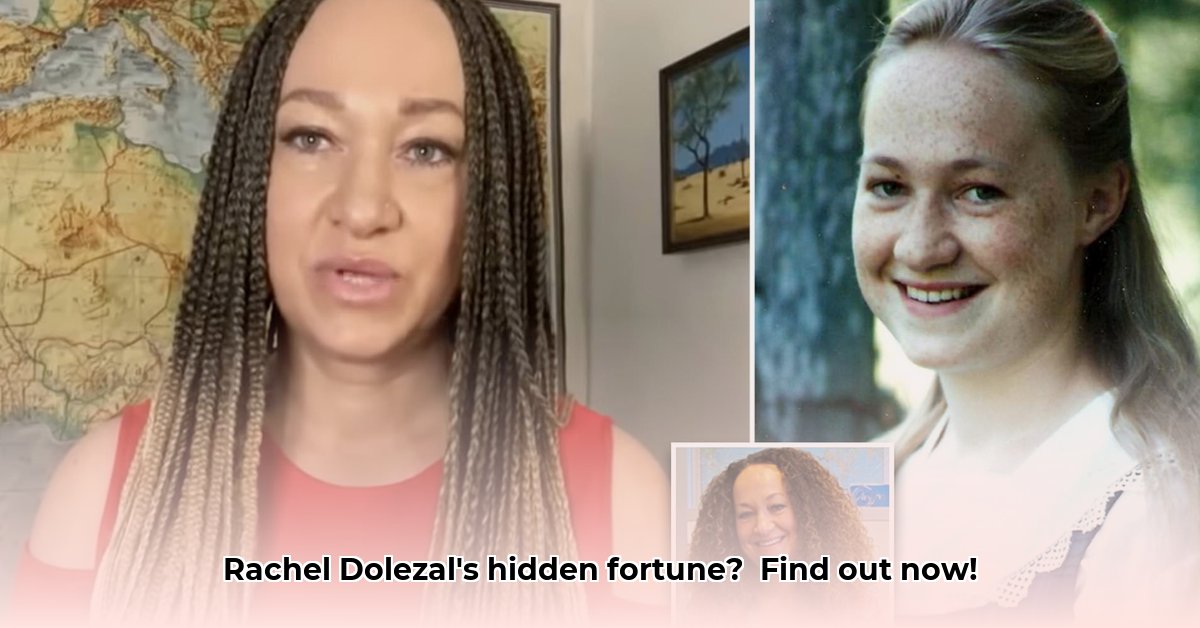
Pinpointing Rachel Dolezal's net worth proves surprisingly difficult. Unlike many public figures whose financial details are often readily available, Dolezal's case presents unique challenges. This isn't simply a matter of locating numbers; it's about navigating significant obstacles in accessing and verifying reliable information. Let's explore the reasons behind this intricate puzzle.
The Challenges of Determining Rachel Dolezal's Net Worth
The primary difficulty lies in the scarcity of publicly available financial data related to Rachel Dolezal. She hasn't publicly disclosed her income, assets, or liabilities, leaving any attempts at establishing a net worth reliant on conjecture rather than verifiable fact. This lack of transparency raises questions about the broader challenges of assessing the wealth of private individuals, particularly those who actively seek to maintain their financial privacy. How much, for example, do we really know about the financial situations of individuals in highly scrutinized positions?
The Enigma of Missing Financial Records
Unlike celebrities who often (or whose representatives often) share details of their finances, Dolezal has maintained a degree of privacy in this area. This makes confirming any reported figures on her net worth virtually impossible. We are left with speculation, not concrete data. The information vacuum makes verifying any claims about her assets exceptionally difficult. This lack of transparency isn't unique to Dolezal; many individuals, even public figures, effectively shield their financial information from public view.
The Impact of Controversy and Media Scrutiny
The controversy surrounding Dolezal's self-identification has undoubtedly contributed to her desire for financial privacy. The intense media attention surrounding her case likely amplified this desire further. This highlights the complex interplay between public interest, individual privacy rights, and the challenges of responsible media reporting on sensitive personal information. How can the media balance public curiosity with respecting an individual's right to privacy, especially when financial information is involved?
The Limitations of Traditional Investigative Methods
Researchers typically rely on public records, property ownership details, and business registration information to estimate an individual's net worth. These methods prove largely ineffective in Dolezal's case. Even sources that initially seem reliable often lack verifiable details about her finances. The usual pathways to uncovering financial information simply don't yield results in this particular situation. Why is this the case, and what alternative approaches might be considered?
The Media's Role: Balancing Information and Speculation
Media outlets significantly influence public perception of a celebrity's or public figure's wealth. The absence of verifiable information about Dolezal's finances created a fertile ground for speculation and unconfirmed reports. This underscores the critical importance of responsible journalism – rigorously verifying information before publication and avoiding the spread of inaccurate or misleading data. This is particularly crucial when dealing with controversial public figures, where the potential for misinformation is high. What ethical considerations should guide media reporting on the financial affairs of individuals who maintain their privacy?
Estimating Net Worth: A Methodological Approach
While determining Rachel Dolezal's precise net worth remains impossible given the current lack of verified data, a structured approach using various investigative techniques offers a more informed perspective. This process, however, inevitably encounters significant limitations.
Strategies for Estimation: A Multifaceted Approach
Though a precise figure remains elusive, several strategies could provide a more comprehensive understanding:
Public Records Review: Examination of publicly available records, including property records and business registrations, might uncover some financial clues. While unlikely to reveal a complete picture, these sources can offer fragments of information.
Social Media Analysis (with Caution): Social media profiles, while not a direct source of financial data, can sometimes indirectly suggest an individual's lifestyle and spending habits. However, this should be interpreted cautiously and never used as primary evidence.
Professional Network Analysis: Investigating professional connections and past employment could offer insights into potential income streams and assets. Again, this would provide only a partial picture of the larger financial landscape.
Lifestyle Assessment (Highly Speculative): Assessing an individual's lifestyle through observable choices offers indirect clues about their financial means. This, however, is notoriously unreliable, as appearances can be extremely deceptive.
Comparative Analysis (Limited Applicability): Comparing Dolezal's potential earnings to those of similarly situated individuals might offer a rough estimate. Many factors would need to be considered to make this a remotely useful comparison.
The Limitations of Estimation
It's crucial to acknowledge inherent limitations:
- Undisclosed Assets: Significant assets might remain hidden, including offshore accounts and trusts.
- Debt Levels: It's difficult to determine any outstanding debts, which significantly influence net worth calculations.
- Asset Valuation Challenges: Accurately valuing assets, such as art or privately held businesses, can be difficult.
- Income Fluctuation: Income sources might be inconsistent, making current net worth estimation challenging.
Key Takeaways:
- Determining the net worth of private individuals who actively maintain their financial privacy presents significant challenges.
- Multiple data sources can offer fragments of information, but a precise figure often remains unattainable.
- Transparency and acknowledging the limitations of any estimations are critical for responsible reporting.